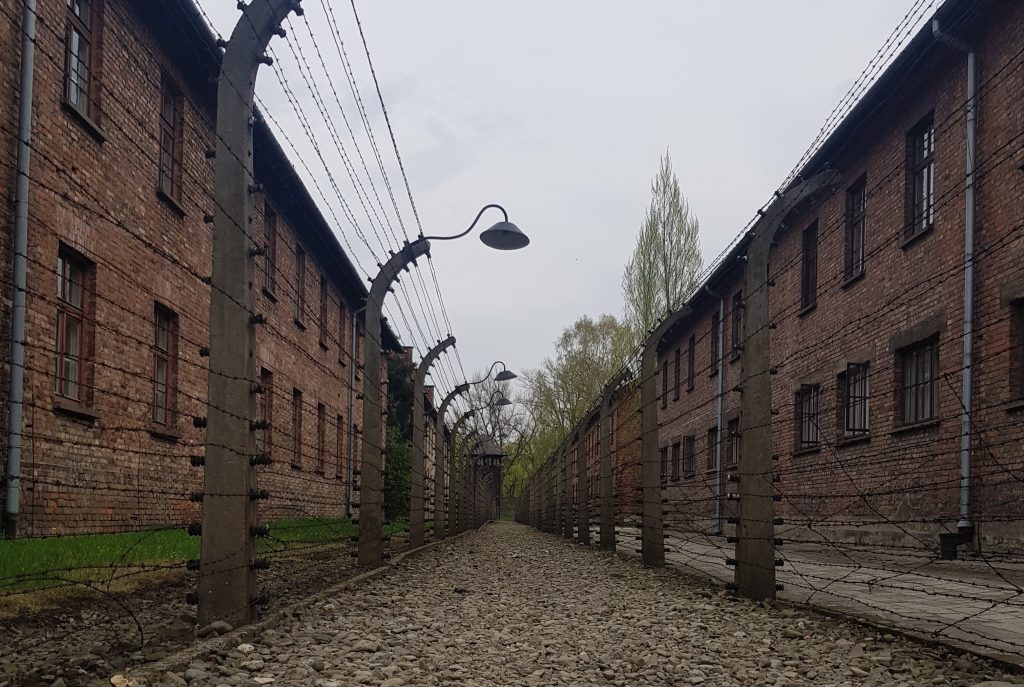
Prisoners of the Auschwitz III –Monowitz camp were mostly forced laborers, mainly Jews, prisoners of war and political prisoners. Many of them died as a result of malnutrition or exhaustion. They were subjected to inhuman working conditions.
Camp Monowitz is a monument that denies humanity. Apart from this camp, listed next to Auschwitz I and Auschwitz II Birkenau, there were several dozen sub-camps that played similar roles. The scale of the atrocities of the Nazis during World War II is not only unimaginable, but also forces humanity to strive for tolerance and good, not harm towards other people.
In order to make greater use of the prisoners’ labor force, branch camps of KL Auschwitz were established in 1943 at industrial plants (the largest sub-camp in Monowice). About 40 branches of the Auschwitz camp were established. Plants and factories of German concerns benefited from the slave labor of prisoners.
The history of the Monowitz:
In October 1942, the Auschwitz III camp was established, whose prisoners worked for the needs of the IG Farbenindustrie concern (Buna-Werke plant).
At the end of 1944, in the face of the approaching Red Army offensive towards Oświęcim, the camp authorities began to cover up the traces of the crime. Documents were destroyed, some objects were demolished, others were burned or blown up. In mid-January 1945, an order was issued for the final evacuation and liquidation of the camp.
Prisoners able to walk were evacuated at the end of January 1945 deep into the Third Reich, when Soviet soldiers were only 60 km from the camp, liberating Krakow. On January 17-21, 1945, about 56,000 men and women prisoners were led out of KL Auschwitz and its sub-camps in foot evacuation columns, escorted by armed SS men. Prisoners walked on foot, without food, in frosty weather. Many of them lost their lives during this tragic “evacuation” known as the death march. In January, the Nazis blew up the gas chambers and crematoria of KL Birkenau. On January 27, 1945, Soviet troops of the 1st Ukrainian Front liberated the camp. There were 7,500 survivors there, including 180 small children.
Historians estimate that a total of 1.3 million prisoners passed through the Auschwitz-Birkenau concentration camp, including 1.1 million Jews. Jews made up 90% of Auschwitz prisoners. Most of them died in the gas chambers.
The Supreme National Tribunal assumed that 2.8 million people died in Auschwitz and its sub-camps. Pursuant to the resolution of the Sejm of the People’s Republic of Poland of July 2, 1947, the grounds of the former camp in Oświęcim, together with all buildings and devices, were preserved as a monument to martyrdom – the Oświęcim-Brzezinka State Museum.
On June 27, 2007, UNESCO changed the name of the camp to Auschwitz-Birkenau. German Nazi concentration and extermination camp (1940-1945). The Polish government sought the change, above all, to reflect the historical truth about the real character of the camp, and to precisely refer to the name of the Nazi regime in Germany.